
Owen Tippett is flying.
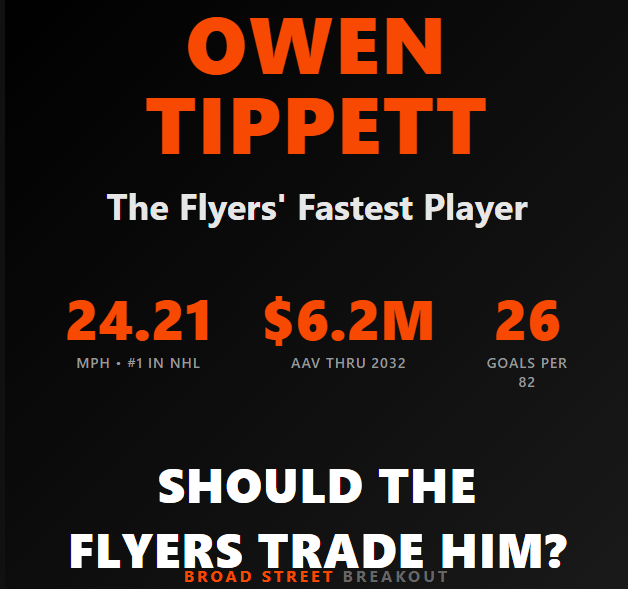
Through the first six games of the 2025-26 season, the 26-year-old winger has already racked up 5 goals and has been the Flyers best offensive player thus far. His blazing speed (clocked at 24.21 mph—literally the fastest skater in the NHL) and shot (99.97 mph) have showcased him as having the potential to be one of the league’s most dangerous offensive weapons.
And he’s locked in at just $6.2 million per year through 2031-32.
So naturally, the question every Flyers fan is asking: Should we trade him?
It sounds insane on the surface. But here’s the thing—context matters. The Flyers are still 2-3 years away from contending. They desperately need a #1 defenseman. And they have an absolute embarrassment of riches at the wing position, with elite prospects Porter Martone, Alex Bump, and Denver Barkey all knocking on the door.
So let’s break this down like we do on Broad Street Breakout: cold, hard data mixed with gut-check reality. Is Owen Tippett untouchable? Or is this the exact moment Danny Brière should be shopping him?
Let’s dive in.
The Case FOR Owen Tippett: Elite Tools, Team-Friendly Deal, Entering His Prime
The Fastest Player in Hockey
Let’s start with the most undeniable fact: Owen Tippett is the fastest skater in the NHL.
According to NHL EDGE stats, Tippett recorded a max speed of 24.21 mph during the 2024-25 season—the highest in the entire league. He also ranked in the 98th percentile for 20+ mph bursts, meaning he hits top speed more often than almost anyone else.
Speed like that doesn’t decline quickly. Unlike skill or hockey IQ, elite skating is one of the last tools to erode as players age. Tippett’s game is built on getting to loose pucks first, driving the net, and creating separation. Those are timeless attributes.
Shot Volume Machine
Tippett doesn’t just skate fast—he shoots. A lot.
In 2024-25, Tippett ranked 6th in the entire NHL in individual shot attempts per 60 minutes (iCF/60) at 20.21. That’s elite company. And his shot isn’t just frequent—it’s devastating. His average shot speed of 99.97 mph puts him among the hardest shooters in the league.
Volume shooting is one of the most sustainable offensive metrics. Even when the goals dry up, the underlying process remains. Tippett creates offense by sheer force of will, and that doesn’t go away overnight.
The Contract is a Steal (And Getting Better)
Here’s where things get really interesting.
Owen Tippett signed an 8-year, $49.6 million extension in 2023, carrying a cap hit of $6.2 million per season through 2031-32. At the time, it seemed like a fair deal for a 25-goal scorer. But with the NHL salary cap exploding, this contract is about to become one of the league’s best bargains.
The salary cap is projected to rise as follows:
- 2025-26: $95.5 million
- 2026-27: $104 million
- 2027-28: $113.5 million
That means Tippett’s $6.2M cap hit will go from 7.0% of the cap this season to just 5.8% in 2026-27 and potentially under 5.5% by 2027-28.
For a 25-30 goal scorer who generates elite shot volume, plays a power game, and can skate like the wind? That’s an absolute bargain. Comparable wingers signing today would command $8-10 million AAV in the current market.
The Breakout That Never Happened… Until Now?
One criticism of Tippett has been consistency. He’s streaky—red hot one month, ice cold the next. But here’s what people miss: the underlying metrics have always been there. Even during his “down” year in 2024-25, when he “only” scored 20 goals, he still:
- Led the team in shots on goal (188)
- Ranked in the 98th percentile for skating speed
- Finished with 43 points in 77 games
- Delivered 76 hits and played solid two-way hockey
The narrative around Tippett being inconsistent is starting to feel outdated. Since coming to Philadelphia, he’s averaged 26 goals per 82 games over three seasons. That’s not a fluke—that’s production.
And let’s not forget: Tippett spent years buried on Florida’s depth chart averaging 12 minutes a night. Since getting legitimate top-six ice time under John Tortorella, he’s become a legitimate 25-30 goal threat. Players often don’t hit their prime until 26-28. What if Tippett is just getting started?
The Case AGAINST Owen Tippett: The Winger Logjam & Opportunity Cost
Porter Martone & The Prospect Wave
Here’s where things get complicated. The Flyers don’t just have one elite winger prospect—they have several.
Porter Martone, the 6th overall pick in 2025, is a 6’3″ power forward with elite skill and creativity. He’s heading to Michigan State and is projected as a future top-line scoring winger. The Athletic’s Corey Pronman gives him a “bubble NHL All-Star” projection. Translation: he could be better than Tippett.
Alex Bump absolutely dominated at Western Michigan (47 points in 42 games) and looks NHL-ready. He’s a pure scorer with a high-end shot, and the Flyers rave about him. Assistant GM Brent Flahr said, “He looks like an NHL player to me going forward.”
Denver Barkey was one of the top OHL scorers the past two seasons (1.61 PPG) and has elite playmaking ability. While undersized, he’s a workhorse with top-six upside.
Then there’s Matvei Michkov (63 points as a 19-year-old rookie), Tyson Foerster (20-goal scorer at 22), and Nikita Grebenkin (physical, skilled forward acquired at the deadline).
Bottom line: The Flyers have an embarrassment of riches at the wing position. Martone alone could render Tippett expendable in 2-3 years. If you’re going to trade Tippett, now is the time to maximize his value before the prospect wave crashes into the NHL roster.
The Taylor Hall Disaster: Why Trading Offense for “Good” Defense Never Works
Before we even get to the Jeff Carter mistake, let’s talk about what happens when teams trade elite offensive players for defensemen who aren’t truly elite.
June 29, 2016. The Edmonton Oilers trade Taylor Hall—a 24-year-old former #1 overall pick and Hart Trophy-caliber winger—to the New Jersey Devils for defenseman Adam Larsson.
At the time, Oilers GM Peter Chiarelli justified it: “We needed a defenseman.” And he was right—Edmonton’s defense was terrible. But here’s what actually happened:
Taylor Hall after the trade:
- Won the Hart Trophy (2018)
- 93 points in 76 games during MVP season
- Consistent 50-60 point player when healthy
- Still playing in the NHL at a high level
Adam Larsson after the trade:
- Solid second-pair defenseman
- Never became the #1 guy Edmonton needed
- Eventually left Edmonton in free agency (2021)
- Good player, but not franchise-altering
The trade became a punchline across the NHL. Edmonton didn’t get the elite #1 defenseman they needed—they got a “good” defenseman. And they gave up a generational offensive talent to get him.
The lesson is crystal clear: Unless you’re getting a legitimate, proven, top-pair defenseman who can eat 25+ minutes and drive play at both ends, don’t trade elite offensive weapons. “Good” defensemen don’t win Stanley Cups. Elite ones do.
The Flyers can’t make the Hall-Larsson mistake with Owen Tippett. Trading a 26-year-old, 30-goal winger on a $6.2M deal for a “solid second-pair guy” would be organizational malpractice.
The Andreas Athanasiou Warning
Let’s talk comps. Tippett’s game—elite speed, streaky scoring, volume shooter—mirrors a few NHL players, and not all of them aged well.
Andreas Athanasiou is the cautionary tale. Like Tippett, Athanasiou was a burner who could fly down the ice and rip shots. He even had a 30-goal season (2018-19 with Detroit). But inconsistency plagued him. He bounced around the league, never finding sustained success, and is now a depth player.
The difference? Athanasiou never developed the two-way game or consistency that Tippett has shown. But the warning is real: speed merchants who rely on pure athleticism can flame out if they don’t evolve.
On the flip side, there’s Brock Nelson—a late bloomer who didn’t hit 30 goals until age 27 and has now been a consistent 25-30 goal scorer for years. Or Jeff Skinner, who struggled for years before finding his groove again.
The question: Is Tippett on the Athanasiou path or the Nelson trajectory?
The Jeff Carter Nightmare: A Flyers History Lesson
Before we talk about trading Tippett for a defenseman, let’s talk about the last time the Flyers traded away a proven goal scorer.
June 23, 2011. The Flyers trade Jeff Carter—a 26-year-old center coming off a 36-goal season—to Columbus for Jakub Voracek and draft picks (that became Sean Couturier and Nick Cousins).
At the time, it seemed defensible. Carter had a monster contract ($5.27M AAV through 2023), the Flyers needed cap flexibility, and Voracek was a promising young winger. But here’s what happened:
Jeff Carter’s career after leaving Philly:
- 2x Stanley Cup Champion (2012, 2014 with LA)
- 421 goals in 1,151 NHL games
- Consistent 20-30 goal scorer for over a decade
- Played until age 38
The Flyers’ search for Jeff Carter 2.0:
- Spent the next 15 years trying to replace a 30-goal scoring center
- Cycled through countless forwards: Schenn, Laughton, Hayes, etc.
- Never found that consistent goal-scoring punch down the middle
The Carter trade haunts Flyers fans to this day. Not because Voracek was bad (he wasn’t), but because the Flyers gave away a 30-goal scorer in his prime and spent over a decade searching for his replacement.
Sound familiar?
Owen Tippett is 26 years old. He’s averaged 26 goals per 82 games since joining the Flyers. He’s on a team-friendly deal through his prime years. Trading him for a “good” defenseman could be the Jeff Carter mistake all over again—except this time at wing.
The Flyers’ Desperate Need for a #1 Defenseman
Let’s be brutally honest: the Flyers’ defense is a mess.
They don’t have a true #1 defenseman. Travis Sanheim is solid but more of a 1B. Cam York and Jamie Drysdale are promising but unproven. The blue line is the single biggest weakness holding this team back from contention.
Now imagine this scenario: A team calls Danny Brière and offers a legitimate top-pairing, left-shot defenseman for Tippett. Someone in the prime of their career, signed long-term, with proven two-way ability.
That’s the type of trade that could accelerate the rebuild by 2-3 years. The Flyers could slot that defenseman alongside Sanheim, give York easier matchups, and suddenly have a defense capable of competing in the Metro.
The risk? Giving up a 26-year-old, potential 30/40-goal scorer on a team-friendly deal for a player who doesn’t move the needle enough.
The Verdict: Keep Him, But Listen to Offers
Here’s my take: Don’t trade Owen Tippett unless you’re blown away by the offer.
Why?
- His contract is a bargain in a rising cap era—$6.2M will feel like nothing in two years.
- He’s entering his prime—Most power forwards peak at 26-29. Tippett just turned 26.
- He’s elite in key areas—Speed, shot volume, and work ethic don’t decline easily.
- The prospect wave isn’t here yet—Martone is 2-3 years away. Bump needs time. Barkey is undersized. You can’t bank on maybes.
- The Hall-Larsson trap is real—Trading elite offense for “good” defense rarely works.
- The Flyers already made this mistake with Jeff Carter—They traded a 30-goal scorer in his prime and spent 15 years trying to replace him.
But here’s the caveat: If a team offers a proven top-pair, minute-eating, left-shot defenseman, you listen.
The problem? Those guys don’t grow on trees—and the market is basically barren right now.
Noah Dobson? Already gone. Montreal scooped him up in June 2025 in a sign-and-trade (8 years, $9.5M AAV) for two first-rounders and Emil Heineman. The Islanders cashed out, and the Canadiens got their man. That ship has sailed.
Bowen Byram? Technically available, but here’s the catch: Buffalo just signed him to a 2-year, $6.25M bridge deal that walks him straight to unrestricted free agency in 2027. That’s not a “proven top-pair guy with term”—that’s a rental with question marks. Byram put up solid numbers last year (38 points, played all 82 games), but he’s still searching for consistency and has a concussion history. The Sabres could flip him at the deadline, but trading Tippett for that is a massive gamble.
Rasmus Dahlin? Buffalo’s captain just signed an 8-year, $11M AAV extension and has publicly denied trade rumors. He’s untouchable unless the Sabres completely implode—and even then, his cap hit makes a deal nearly impossible.
So who’s left? The market for legitimate, proven, top-pair defensemen is essentially nonexistent right now. You’re looking at second-pair guys, aging rentals, or unproven prospects.
The Flyers need defense desperately. But they can’t afford to make the Hall-Larsson mistake. Trading a 26-year-old, 30-goal winger on a team-friendly deal for a “solid” second-pair defenseman would be a franchise-altering blunder.
Bottom Line Up Front
Owen Tippett is the fastest player in hockey, locked into a team-friendly deal just as the salary cap explodes. The Flyers desperately need a #1 defenseman, but they can’t afford to repeat the Jeff Carter disaster or Edmonton’s Taylor Hall mistake. Unless the return is a legitimate, proven top-pair guy—not a “solid” second-pair defenseman—keep Tippett, maximize his prime years, and bet on his elite tools.
The Flyers spent 15 years trying to replace Jeff Carter after trading him at 26. Don’t make that mistake again with Tippett.
With the cap rising, prospects coming, and Tippett entering his prime, the smart move is patience. Don’t panic-trade an asset in a hockey trade unless you’re getting back a true difference-maker on defense.
What do you think, Flyers fans? Is Tippett untouchable, or is there a defenseman out there worth the risk?
Discover more from Broad Street Breakout
Subscribe to get the latest posts sent to your email.
Talk hockey on X. Watch the film breakdowns on Instagram.