
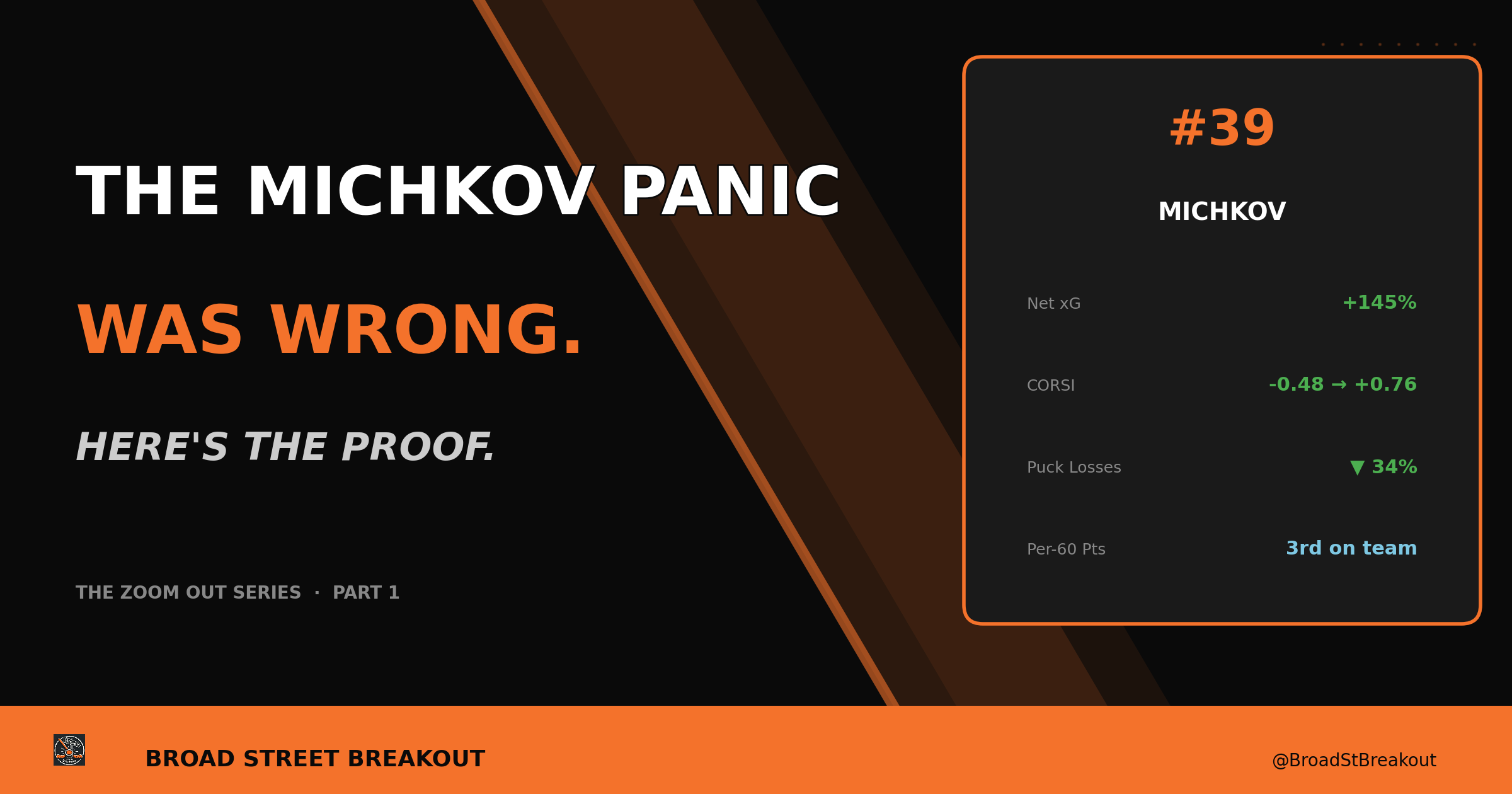
Why Tocchet is right, why the fanbase needs to zoom out, and what the InStat data actually says about Michkov’s sophomore season.
Hey everyone — it’s been a minute. What can I say, life got in the way.
When I started Broad Street Breakout last offseason, I was at a job that gave me more flexibility, but it was never going to be a long-term thing. Around July I moved into a new role that I absolutely love, but between the travel and the hours, it ate into my free time in ways I didn’t anticipate. On top of that, coaching this year became an entirely different animal. For the prior four years I coached the 2010 age group — had some unbelievable kids come through, one just got selected to the USNTDP U17 roster and another tendered in the USHL before his U16 season. This year I moved to Bantam Major with the 2011 birth year and it was an up-and-down ride. One of the hardest schedules in the country. But we bounced back, got hot at the end, won some big games, and made it to the district semi-finals. That’s how it goes.
I’ve been on X this entire season, mostly lurking, only chiming in a handful of times. And the discourse around this team — specifically around one player — has been something else. So here it is.
This is Part 1 of the Zoom Out Series. My position is simple and I’m not going to dance around it:
Matvei Michkov is capable of being a generational talent. But he needs to learn how to play the game the right way first. What Tortorella started and what Tocchet is continuing will benefit him for the next decade if he buys in. Should he probably play more at times? Yes. But we need to trust the process and not try to rush it. His ice time will come.
That’s the thesis. Everything below is the evidence.
What Actually Happened
Last year Michkov put up 26 goals and 63 points in 80 games as a rookie. He should have been a Calder finalist. He tied Celebrini for the rookie scoring lead and led the Flyers in goals. The bar was set sky-high.
This offseason, Michkov dealt with an ankle injury that disrupted his training. He made a choice — not a great one — to prioritize the gym over getting back on the ice early. The logic wasn’t crazy: everyone had been telling him to get stronger, absorb more contact, win more puck battles. So he hit the weight room hard. But his on-ice timing, his rhythm, his feel for the game at NHL speed — that stuff atrophied. The organization’s assessment was that he showed up to camp out of shape from a hockey conditioning standpoint, and Michkov has essentially admitted as much.
Then the coaching change. Tocchet’s system is entirely different from Torts. Different structure, different expectations, different communication style. And the language barrier for a 20-year-old Russian kid trying to process complex systems from an intense older coach who communicates through nuance — that’s harder than anyone gives it credit for. Michkov’s English has improved dramatically, but getting coached hard in your second language is a real adjustment that native English speakers don’t have to think about.
On top of all that, Tocchet moved him from right wing to left wing. Michkov said it himself in February: “I was always playing the right. Now I’m playing on the left. It’s a new role. For me, on the right, I can create a lot more moments.”
New coach. New system. New position. Conditioning issues. Language barrier. Franchise expectations. He’s 21. And people were surprised he had a rough couple of months.
The Ice Time Debate — And What People Are Missing
The loudest argument on Flyers Twitter all season has been: give Michkov more ice time and his numbers would be better. Fans have been using analytics to make the case — his per-60 production rate is third on the team behind Konecny and Zegras despite playing 4+ fewer minutes per game.
(See Chart: Michkov Per-60 Production vs. Teammates)

I get it. And I actually agree that he should be playing more. But here’s the part nobody wants to consider: there’s a real possibility that with MORE ice time in the wrong situations, his numbers could have been worse.
Michkov at 14:53 per game in sheltered offensive-zone situations with manageable matchups can look really good. Michkov at 18+ minutes getting thrown over the boards against top shutdown lines, penalty-killing, playing high-leverage defensive shifts — that’s a different ask for a player whose skating is still not at elite NHL level and whose defensive positioning is still a work in progress.
The per-60 numbers look great. I’m not disputing them — they’re real and they matter. But per-60 in sheltered minutes doesn’t automatically translate to per-60 in top-line minutes against Aho, Crosby, and Barkov. Tocchet knows that. And whether we like how he’s managed the minutes or not, the underlying logic isn’t crazy.
Do I think there were stretches where Michkov deserved more than 12-13 minutes? Absolutely. Do I think the third-line deployment went on too long at times? Yes. But the idea that more ice time automatically equals better results ignores the reality of what Michkov still needs to develop. His ice time will come when he earns it consistently, and the post-Olympic break surge — where his TOI jumped to 15.5 minutes and his +/- flipped positive — shows that Tocchet is rewarding improvement in real time.
What the Box Score Won’t Tell You
I pulled all of Michkov’s InStat data this season and compared it against his rookie year. The box score says he regressed. The underlying data tells a different story.
(See Chart: Michkov Year 1 vs. Year 2 — What Improved, What Declined)

The short version: yes, goals, assists, points, entries, and dekes are all down. Those are the numbers people see and the numbers that drive the panic. But his Net xG improved 145%. His CORSI flipped from negative to positive. His puck losses dropped significantly. His hits nearly doubled. His +/- improved.
But I don’t want to just throw numbers at you. Let me show you what I mean.
Watch this play. Michkov picks off a pass in the neutral zone, immediately hits Couturier with a great cross-ice pass, and then — this is the part people miss — he doesn’t admire the pass. He crashes the net. He gets the puck back in the high slot and has a mini breakaway. Doesn’t score. Doesn’t show up on the scoresheet. But it’s plays like this that tell you everything you need to know about where he’s headed long term. The read, the pass, the effort to get to the net — that’s a complete sequence from a player who people were calling lazy two months ago.
This one I love. He enters the zone on a 2-on-2. A lot of young skill players force that play — try to beat the defender, go wide, take the shot. Michkov recognizes he has a third guy coming late and the 2-on-2 isn’t the right play. He pulls up, drops it to the trailer in Brink. Stays open for the pass back. Gets it and takes it behind the net — and here’s the key — he’s still facing the rest of the ice the entire time. Pre-scanning. Reading his options before he even has the puck on his stick. He finds Brink again behind the net, works it around, and eventually finds Juulsen crashing which leads to a great scoring chance off the post.
His patience is on full display here. You can see he’s confident with the puck when given time and space. That’s not a player who’s lost or confused or “doesn’t care.” That’s a player whose hockey IQ is operating at an elite level even when the goals aren’t coming.
One more. Michkov with a clean zone entry — and look, he’s not going to burn guys wide with pure speed. That’s not his game and it may never be. But he’s great at getting into the zone, pulling up, surveying his options, and finding the right play. Here he hits Barkey in the slot. But most importantly — and this is the detail that casual fans miss and analytics don’t capture — he doesn’t just stand still after the pass. He immediately moves to open ice. He’s trying to get that puck back. He wants to be part of the next play, not a spectator. That’s a detail that doesn’t show up in any stat sheet but it’s exactly the kind of play that earns a coach’s trust over time.
Now look at his 5-on-5 goal charts from InStat.

24-25 Michkov 5v5 Goal Locations

25-26 Michkov 5v5 Goal Locations
The goals are coming from the same areas — the slot, right in front, the crease. That hasn’t changed, and that’s a good thing. He’s still scoring from the places where NHL goals are scored. What you lose a little this year are some of the shots out to the right side that went away when he moved to left wing for most of the season — which makes sense. But overall the shot profile is the same. It’s just happening at a lower clip. The issue isn’t where he’s shooting from. It’s how often he’s getting the chance to shoot. And that comes back to ice time, deployment, and the linemates around him.
The puck protection is there. The hockey IQ is elite. The playmaking ability and the shot are All-Star caliber. What’s missing is the skating — he’s not an elite NHL skater and it shows — and the consistency of doing the hard things without the puck for a full 60 minutes, not just in flashes. He can’t just be a player who looks dangerous off the rush but disappears in a possession game. He needs to be a complete player. And that takes time.
The Bedard Blueprint
I pulled InStat data on all three of Connor Bedard’s NHL seasons and put them side by side with Michkov’s.
(See Chart: Bedard Year 1 → Year 2 → Year 3 vs. Michkov Year 1 → Year 2)

The pattern is identical. Bedard’s sophomore year saw his points dip, his inner slot shots cut in half, his slot passes crater, and his Net xG go negative. He was getting roasted on TNT. Biz was hammering him on Chiclets. The narrative in Chicago was rough.
Then Year 3 happened. Points exploded to a point-per-game pace. Entries jumped from 7 to 10. Slot passes more than doubled. Dekes nearly doubled. He came back a more complete player because his coaches held him accountable, pushed him through an uncomfortable year, and refused to let him coast on talent.
That’s the roadmap. The sophomore slump didn’t break Bedard. It made him better. And I believe the same thing is happening with Michkov right now.
Look at Michkov’s own arc within this season. Pre-Olympic break: 0.53 points per game, -0.13 +/-, 14.5 minutes average TOI. Post-break: 0.65 points per game, +0.05 +/-, 15.5 minutes TOI. Assists jumped 67%. He went from a net negative to a net positive on the ice.
(See Chart: Michkov Pre-Olympic Break vs. Post-Olympic Break)

The trajectory is there. It just requires patience.
Why Tocchet (and Torts) Will Be Appreciated in 5-10 Years
I’m not going to play both sides here. I’m going to say what I believe.
If Michkov buys in fully — and the post-break surge suggests he’s starting to — we will look back and appreciate what Tortorella started and what Tocchet is continuing. Five years from now, ten years from now, when Michkov is in his prime playing a complete 200-foot game with elite offensive production on top of it, the work being done right now is what will have made that possible.
I know guys who coached Alexander Semin and Ovechkin in Washington. They’ll tell you Semin was more skilled than Ovi. More natural talent, softer hands. And where is Semin now? Out of the league a long time ago because he refused to adapt. He relied on skill and it worked until it didn’t.
Kuznetsov — same story. Unbelievable talent. Could he still be playing in the NHL if teams trusted his commitment and his defensive game? Probably. But they don’t.
Now think about Ovi. The greatest goal scorer who ever lived didn’t win a Cup until Trotz got him to buy in defensively at age 32. If you asked Ovi whether he’d rather have learned that at 21, I’d bet everything I have he’d say yes — and that it probably would have meant more Cups.
The biggest knock on Russian players coming to the NHL has always been that they don’t learn defense because they’ve never needed to. Every coach they’ve had growing up played them heavy minutes regardless, because the talent was obvious and winning was the priority. Someone else’s problem. Michkov was loaned from SKA in the KHL because their coaches weren’t going to give him 17-20 minutes a night with his defensive habits. A lower-level team took him because what do they care about defense — they needed someone who could score.
What Tocchet is teaching Michkov right now is the hardest lesson a skill player has to learn: your talent alone isn’t enough. You have to respect the game for the game to respect you back.
And it’s working. Watch this play.
This is against Washington. The Capitals winger has the puck along the boards and Michkov does a great job of making him look open — giving him just enough space to think he has a play — and then immediately suffocating him. Wins the puck clean. And here’s what separates a good defensive play from a great one: he has enough poise and awareness after winning the battle to pick his head up and make a clean breakout exit instead of just chipping it off the glass. Read. Recover. Exit. That’s a complete defensive sequence, and it’s the kind of play that was almost nonexistent in his game a year ago.
That’s what buying in looks like.
What Still Needs to Improve
I’m being honest in this piece about why Michkov is going to be fine long term, so I need to be equally honest about what still needs work. Because Tocchet isn’t limiting his ice time for no reason.
This is on the powerplay in a one-goal game. Michkov is pressured by TVR. He has just enough time to pull up and slow it down to set up the powerplay — the right initial read. But the execution isn’t there. He turns it over and sends Washington the other way. In a one-goal game. On the powerplay. These are the reps that need to get sharper, and they’re the reps that only come with experience and confidence in your own game.
This one is harder to watch. Montreal. It’s 4-4 with a minute thirty left in the game. Michkov gets back during a frantic sequence around the Flyers’ net — he makes the right initial read to get back into the play. But then he has two or three puck touches and every single one leads to Montreal getting the puck back. In a tie game. With under two minutes left.
These are the plays that have to drive Tocchet and the staff crazy. You want him out there to score. You want his talent on the ice in those moments. But you can’t turn the puck over repeatedly when you’ve made the right initial reads in a close game. The reads are there. The execution under pressure isn’t — yet.
And this is the skating. Michkov probably needs to get lower on the breakout here. In today’s NHL the defense or F3 crash down on any 50/50 puck they think they can win. If he’s lower, they wouldn’t be able to go down on him and he’d have possession. Instead Letang gives pseudo pressure and Michkov turns it over up the wall. Then he gets caught skating in a circle, and when he tries to win it back Kindel blows right by him. Two minutes into the game and instead of playing offense we’re now playing defense.
This is what Tocchet sees. This is why the ice time isn’t always there. And this is what a strong offseason focused on skating and explosiveness can fix. The IQ told him to be in the right spot. The feet couldn’t get him there fast enough. That gap between his brain and his skating is the single biggest thing standing between Michkov and the superstar ceiling everyone knows he has.
Should they play him more at times? Yes. I’ve said that and I mean it. But the underlying approach — demanding accountability, requiring defensive buy-in, making him earn his minutes — that’s not mismanagement. That’s development. And his ice time will come.
A Word About the Beat Writers
I need to address this because it got out of hand this season.
Kevin Kurz took more heat than any beat writer I’ve seen covering a Philly team in a long time. His conditioning reporting, the body-fat stories, the “Tocchet wants Michkov to succeed” piece — all of it drew massive backlash. Fans accused him of being an organizational mouthpiece running hit pieces on a 21-year-old Russian kid.
Look — Kurz leans into the Michkov stuff. He knows it drives engagement. He plays the villain role and I think he gets a kick out of it. That’s part of the game when you’re a beat writer in Philadelphia. Charlie O’Connor takes a more measured, data-first approach — his line-combo reporting and ice-time tracking generates analytical discussion rather than quote-tweet wars. Different styles. Both doing their jobs.
But here’s what I know from personal experience. When I started this blog with less than 50 followers and a clipart logo, I reached out to all the top Philly hockey media guys. Kevin Kurz called me and had a 30-minute conversation asking about my background and how he could help. Charlie and Bill Matz responded and even used some of my graphics and analysis on their show. These guys didn’t owe me anything.
They’re real people doing their jobs. Kurz was reporting what the organization was telling him. The team believed Michkov’s conditioning was an issue. He reported it. You can disagree with how Michkov is being handled in Game 53 of 82 — I have my own opinions on the deployment — but that doesn’t make the reporting inaccurate. Sewering these guys on X for doing their job is asinine.
The Linemate Question
Just because Michkov is touted as a generational talent doesn’t mean every teammate loves playing with him right now. This is purely speculation — but maybe Zegras, TK, Coots have said behind closed doors that they don’t fully trust the defensive-zone coverage when Michkov is out there. Maybe not. We don’t know. But being a line that gets scored on kills everyone’s ice time and undermines the team’s ability to win.
The standard for true franchise players is that they can play with anyone and make their linemates better. If he can’t elevate Bobby Brink and Noah Cates and produce with them, is he truly ready for top-line deployment every night?
On April 3rd against the Islanders, he answered that question.
Three points. Playing with Bump and Cates. He set up the Bump goal and made a player who’s been in the NHL for a cup of coffee look like he belonged on a scoring line.
Then the Sanheim goal. Michkov protects the puck entering the zone, reads the trailing defenseman, and threads it to Sanheim in stride for a one-timer that put the game away. That’s vision that can’t be taught.
And it wasn’t just the assist plays. Watch this one from the same game — Michkov picks the puck up from Bump, takes a few strides, and gets a dangerous scoring chance from the slot. He was buzzing all night. 3 points in 11:43 of ice time. Dominated every shift he was on.
That night proved it. He can elevate middle-six linemates. He can produce in the biggest game of the season. He can do it on limited minutes. The question now is consistency — can he do that every night? That’s the next step.
Noah Cates is the real deal as a middle-six center. And Bump on the Flyers all year would’ve been in the Calder conversation — but that’s a topic for another day.
Where We Are Right Now
Going into the Olympic break, the Flyers had lost 12 of 15. The Fire Tocchet crowd was at full volume — a meme about it hit 1,300 likes on February 2nd. Fans wanted Michkov traded. The season looked dead.
Since the break: 12-4-1. The Flyers are at 88 points with 7 games left, alive in the Eastern Conference wild-card race. Michkov had his best game of the season in the biggest moment. Zegras is on pace for career highs. Vladar has been the team MVP. Porter Martone just signed and is in the lineup. Jiricek signed an extension.
The same people who wanted Tocchet fired went quiet. The same accounts calling for Michkov trades are posting celebration clips. That Fire Tocchet meme aged like milk left on Broad Street in July.
That’s not analysis. That’s emotion. And emotion is a terrible way to evaluate a hockey team.
Zoom Out
Matvei Michkov is 21 years old with 103 career NHL points. He just dropped 3 points in a must-win game. He’s improved defensively by every measurable metric this season. His puck losses are down. His Net xG is up. His CORSI is positive. His per-60 rate is third on the team. His goal chart shows he’s getting to better areas than he was as a rookie.
He is capable of being a generational talent. The puck protection, the IQ, the playmaking, the shot — it’s all there. He needs to improve his skating. He needs to learn to play effectively in all situations, not just off the rush. He needs to put it all together into a complete game. And that takes time, coaching, and patience — all things this city is historically terrible at providing.
Bedard had the same sophomore slump and came out the other side at a point-per-game pace. Ovechkin didn’t buy in defensively until he was 32 and won a Cup. The players who commit to playing the right way early in their careers are the ones who end up with rings.
If Michkov buys in, we will appreciate what Torts and Tocchet did for him. The ice time will come. The production will come. Stop treating Game 53 of 82 like it’s Game 7 of the Stanley Cup Final.
Zoom out.
Coming in Part 2: “The Moves You’re Not Talking About” — Vladar as team MVP, Zegras’s career year, Dvorak’s breakout, and why Danny Briere’s offseason was a masterclass the Michkov discourse drowned out.
Coming in Part 3: “The Road Ahead” — Martone’s arrival, the Jiricek extension, what the playoff push means for 2026-27, and why the future is brighter than anyone on X in January wanted to admit.
Ryan Thompson is the founder of Broad Street Breakout and a Tier 1 AAA youth hockey coach in New Jersey. All InStat data and analysis is sourced directly from the InStat platform. Follow BSB on X @BroadStBreakout.
Discover more from Broad Street Breakout
Subscribe to get the latest posts sent to your email.
Talk hockey on X. Watch the film breakdowns on Instagram.