
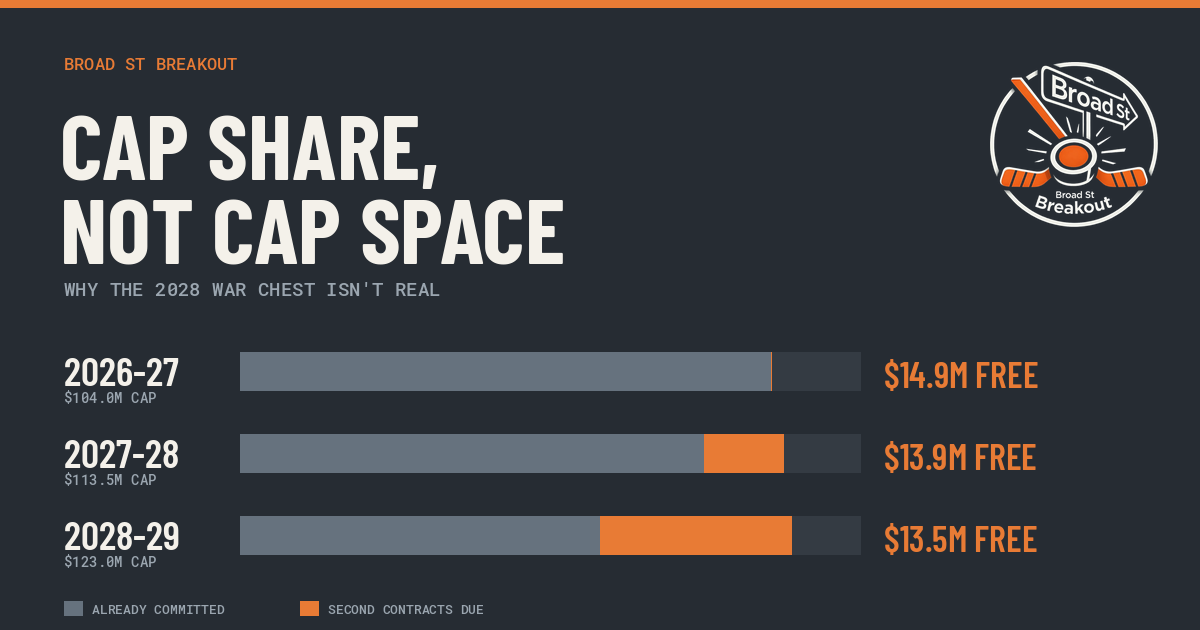
Every time the salary cap jumps, the same conversation starts. The Flyers have room. The Flyers can go get somebody. Danny Briere is sitting on a war chest.
It is worth actually building the model instead of vibing it, because the answer is not what the raw dollar figures suggest. The Flyers do have space. They will almost certainly not have enough of it to be a serious player in 2028 free agency, and the reason has nothing to do with bad contracts. It has to do with the fact that their good young players are about to get paid all at once.
Start with cap share, not dollars
The single most useful correction you can make to how you read contracts right now is to stop thinking in dollars and start thinking in percentage of the cap.
The cap is $104M this coming season, $113.5M in 2027-28, and projected at $123M in 2028-29. Those first two numbers are confirmed by the league and the PA, not estimates. That is a 18.3 percent increase over two years.
What that means in practice is that every existing contract gets cheaper without anyone doing anything. Watch what happens to the Flyers’ core deals as a share of the cap:
| Player | 2026-27 | 2027-28 | 2028-29 |
|---|---|---|---|
| Zegras ($9.125M) | 8.78% | 8.04% | 7.42% |
| Konecny ($8.75M) | 8.41% | 7.71% | 7.11% |
| Couturier ($7.75M) | 7.45% | 6.83% | 6.30% |
| Drysdale ($6.5M) | 6.25% | 5.73% | 5.28% |
| Sanheim ($6.25M) | 6.01% | 5.51% | 5.08% |
| Tippett ($6.2M) | 5.96% | 5.46% | 5.04% |
| York ($5.15M) | 4.95% | 4.54% | 4.19% |
The Zegras deal will only be seven percent contract by the end of the decade. That is fine. That is a good middle-six center number.
This is the part people miss when they panic about a big AAV. Term plus a rising cap is a discount mechanism. It is also why the correct question about Matvei Michkov’s extension is not “how many millions” but “what share are we handing him, and does that share still make sense in year five.”
2027-28 looks flexible. It mostly is.
PuckPedia has the Flyers at $85.02M committed for 2027-28 against a $113.5M cap. That is $28.48M in space, but only 18 of 23 roster spots filled.
The five open spots are Michkov plus four bodies. And here is the underrated piece of this whole exercise: the Flyers already have cheap internal players under contract for that year. Luchanko at $942K, Bonk at $909K, Ciernik at $1.01M, Gill at $933K Fill four holes with those guys and you have spent about $3.8M.
So the real math for 2027-28 is roughly $24.7M available for one player, and that player is Michkov.
Three versions of that:
He repeats last year (around 50 points). Bridge deal. Call it six percent of cap, $6.8M on three years. The Flyers keep about $17.9M in space, and Michkov keeps his leverage for a bigger swing at 24.
He bounces back to the 70-point range. This is the honest projection if you extrapolate his post-Olympic-break rate, which was a 69-point pace over 26 games. That is the Lucas Raymond and Cole Caufield band, roughly 9.5 percent of cap, or about $10.8M on long term. Space drops to about $13.9M.
He actually leaps. Eighty-five points, a real playoff, and now you are in Connor Bedard territory at 14.4 percent. That is $16.4M on the 2027-28 cap. Space drops to about $8.3M.
Notice that even in the expensive scenario, the Flyers are fine in 2027-28. They can absorb a Bedard-level Michkov contract and still ice a legal roster. Cap space is not the constraint that year.
2028-29 is where it gets real
Here is the year everybody is pointing at as the big opportunity, and here is why I think it is a mirage.
The Flyers have 11 players signed for 2028-29 at $71.475M. Against a projected $123M cap, that is 58.1 percent committed and $51.5M of apparent space. That number looks enormous.
It is not, because they need twelve more players, and four of them are going to be expensive.
Everything comes due at once:
- Michkov’s new deal is already running. Whatever he signed in 2027 is on the books.
- Porter Martone hits RFA. His entry-level deal covers 2026-27 and 2027-28 only. If the 2025 sixth overall pick is what the organization thinks he is, his second contract starts here.
- David Jiricek hits RFA as a top-four right shot defenseman, if he has become one.
- Alex Bump and Denver Barkey both hit RFA.
- Joseph Woll hits UFA, so they need a backup goalie.
Run it with the middle Michkov scenario:
| Slot | Cap hit |
|---|---|
| Already committed (11 players) | $71.48M |
| Michkov | $10.78M |
| Martone (second contract) | $8.00M |
| Jiricek | $4.67M |
| Bump | $3.44M |
| Barkey | $2.71M |
| Backup goalie | $2.50M |
| Six ELC and depth bodies | $5.90M |
| Total (23 players) | $109.48M |
That leaves $13.53M, or 11.0 percent of the cap.
Thirteen and a half million dollars in 2028-29 is not a star. It is a good second-line forward or a solid top-four defenseman. It is Trevor Zegras money at that year’s rates. It is not the swing everyone is imagining.
And if Michkov gets to the Bedard tier, that number drops under $8M, which is a depth signing.
Those five contracts are estimates, not predictions, so run your own. The model below lets you set three outcomes for each of Michkov, Martone, Jiricek, Bump, and Barkey and watch both seasons update. Every number in this article is one of the 243 combinations it produces.
Broad St Breakout / Cap Model
Points in,
dollars out
Three contracts in thirty days reset what young stars cost. Give each player a season and the model prices the contract that season earns against a rising cap.
The reset, as a share of the cap
5 x $18M
5 x $18.8M
5 x $15M
the old market
How hot is the market when these deals get signed?
Clear salary · every one of these has trade protection
Chase an elite free agent
2027-28
CAP $113.5M · CONFIRMED
Space remaining
$0.00M
2028-29
CAP $123M · PROJECTED
Space remaining
$0.00M
Committed salary via PuckPedia, July 2026. Pricing curves are fitted to second contracts signed 2022 through 2026 and reweighted for the Carlsson, Bedard and Celebrini reset. Estimates, not predictions of any real negotiation. Production alone doesn’t set price, so each player carries a leverage tier reflecting draft pedigree, projected role and RFA rights. Nick Suzuki got 9.4% of the cap off a 41-point season; Noah Cates got 4.5% off 40. That gap is what the tier represents. Michkov’s cap hit carries into both seasons. Hughes and Makar would sign for 2027-28; McDavid, Matthews and Werenski are 2028 UFAs and only hit the second bar. Rosters filled to 23 with league-minimum bodies.
The uncomfortable part
There is a trap built into this kind of modeling that is worth naming, because it applies to every rebuilding team.
The only way the Flyers have massive cap space in 2028-29 is if Martone, Bump, Barkey, and Jiricek are all cheap. They are only cheap if they are not good. A roster with $30M in space and four failed prospects is worse than a roster with $13.5M in space and four hits.
So when you hear “the Flyers will have cap flexibility,” what you are actually hearing is a bet against their own development pipeline. That is not a plan. That is a consolation prize.
What would have to happen to actually go shopping
If the goal is genuine star-hunting money, meaning something in the $18M to $20M range, the Flyers need to find about $6M to $8M beyond the model above. There are only a few real levers.
Sean Couturier is the obvious one. He is signed at $7.75M through 2029-30, and he will be 36 years old in 2028-29. That is the single worst asset on the books and it is not close. Moving it, by trade, is worth more than any other cap decision the front office can make in this window.
Christian Dvorak at $5.15M through 2030-31 is the second lever. He will be 32 in 2028-29 and that deal has no obvious exit.
A Michkov bridge instead of a long-term deal. This buys short-term space and costs you more later, and it hands the leverage back to the player at exactly the moment he is most likely to have it. I do not love it.
Clear Couturier and you are at $21.28M. That is real money. That is the only version of this where the “big free agency splash” conversation is honest, and you can watch it happen by hitting the Couturier lever in the model above.
Where I land
Here’s the thing I keep chewing on.
The standard line is that stars never reach unrestricted free agency anymore. The 2026 class was thin at every position and everybody good got extended before July. That’s been true for a while and it’s the reason “wait for free agency” has stopped being a real plan for anybody.
But I don’t think Briere is waiting for free agency. I think he’s trying to create it.
Look at what the offer sheet actually did. He put $90 million in front of a 21-year-old center on another team’s roster and had four first-round picks ready to send. Anaheim matched, so it cost him nothing but the filing. What he got out of it was a public demonstration, and the audience wasn’t Anaheim.
Every agent in the sport now knows there’s a team in the East that will pay the number instead of negotiating you down from it. That changes the math for players, not just for GMs.
And players were already leaning this way. Carlsson turned down eight years at $10.5 million last fall and got $18 million by waiting nine months. Carlsson, Bedard and Celebrini all took five years when they could have taken eight, which is a deliberate choice to hit unrestricted free agency at 25 or 26 instead of 29. Celebrini had until September 16 to sign the last eight-year deal the CBA will ever allow and he passed on it.
That’s three of the best young players in hockey betting on the open market inside the same calendar year. The bet only pays if somebody’s actually there to bid when they arrive. Briere just volunteered.
So the play might not be “have money in 2028 and hope somebody good is available.” It might be “be loud enough about paying that more good players decide reaching the market is worth it.” You can’t force a star into free agency. You can make it a more attractive place to end up.
Which is where the model above becomes uncomfortable, because it shows how hard the second half of that is.
The room exists in exactly one summer. In 2027-28 the Flyers have roughly $24.7 million before their own kids get paid. By 2028-29 that’s down to about $13.5 million with Michkov’s raise on the books and Martone, Bump, Barkey and Jiricek all needing deals. And they can’t clear it the easy way, because Konecny has a no-move through 2030-31, Couturier through 2028-29, and Dvorak’s no-trade runs through 2027-28. Tippett is the only meaningful contract Briere can move without asking permission, and even he can block ten teams.
Being the team that pays is a reputation. Actually paying requires space, and the space runs out fast.
There’s one more wrinkle worth sitting with. Michkov is offer-sheet eligible in July 2027. He signed his entry-level deal at 20, so he needs four professional seasons for arbitration rights and will have three. No arbitration. But Group 2 restricted free agency, and offer-sheet eligibility with it, requires only three seasons at that signing age. He’ll have exactly three.
So the GM who spent this summer showing the league that a nine-figure offer sheet is a normal thing to do will spend next summer across the table from a 22-year-old with no arbitration rights, full offer-sheet eligibility, and an agent who watched the whole thing happen.
Briere is trying to change how players think about reaching the market. Hopefully he didn’t succeed with the one player he least wanted to convince.
Cap figures via PuckPedia. Salary cap upper limits for 2026-27 and 2027-28 confirmed by the NHL and NHLPA. The 2028-29 figure of $123M is a projection.
Leave a Reply