
Everybody wants to talk about McDavid to Philadelphia. I get it. He’s a UFA in 2028 and the Flyers are going to have money at some point, so the math feels like it should work.
It mostly doesn’t, and the reason is timing. There are two windows here, they’re a year apart, and the Flyers can realistically only use one of them. Worth laying out which is which.
Who’s actually available, and when
July 2027
- Quinn Hughes, D, 27. Won the Norris in 2023-24 with 92 points. Led the entire NHL in average ice time last season, about three and a half minutes a night more than Rasmus Dahlin, who was 20th. Traded to Minnesota in December for Rossi, Buium, Ohgren and a first. Final year of his deal in 2026-27. Still unsigned.
- Cale Makar, D, 28. Best defenseman alive, probably. Extension-eligible now. Almost certainly re-signs in Colorado.
- Nikita Kucherov, F, 34. Just won the Hart on a $9.5 million cap hit. Elite, but you’d be buying ages 34 through 40.
July 2028
- Connor McDavid, C, 31. Two-year extension expires after 2027-28.
- Auston Matthews, C, 31. Same summer, same agent as McDavid.
- Zach Werenski, D, 31. Six-year, $57.5 million deal ends after 2027-28. Norris finalist last season.
- Crosby will be 41. Not a target.
Jack Hughes is not on either list. He’s signed through 2029-30 at $8 million, so he’s a trade, not a signing. Worth noting he only carries a 10-team no-trade list, which means 22 teams can acquire him without his approval, and on a rising cap that contract gets more valuable every year. If he ever shakes loose, you pay in prospects and picks instead of cap space, which happens to be the resource this team has too much of.
Why 2027 is the real window
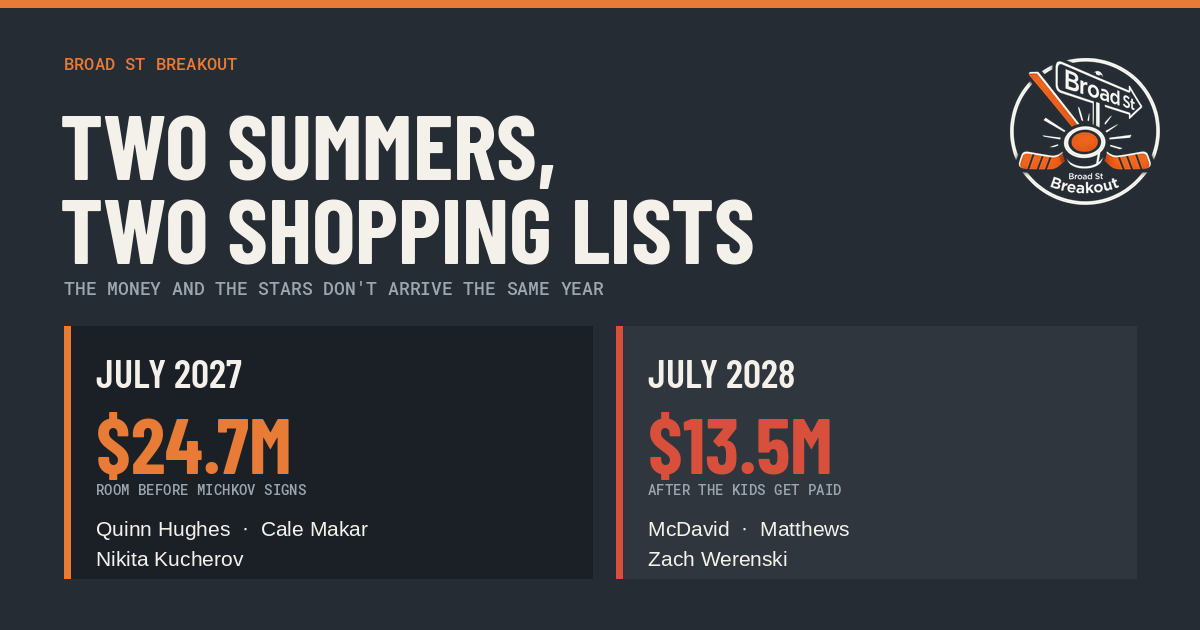
The Flyers have $28.48 million of room in 2027-28 with five roster spots to fill, and four of those spots can be filled with guys already under contract for about $3.8 million total. So call it $24.7 million for one player.
By 2028-29 that’s gone. Michkov’s raise is on the books, and Martone, Bump, Barkey and Jiricek all need new deals in the same year. Run reasonable numbers on all of them and you’re left with something like $13.5 million. That’s a good second-line forward. It isn’t McDavid.
So the summer where the money exists is 2027, and the best player available in 2027 is Quinn Hughes.
What Hughes costs
The Athletic’s Dom Luszczyszyn wrote recently that if Dahlin hit the open market he’d be asking for something near Kaprizov’s $17 million, and that it’s in line with what Makar and Hughes will want. ESPN ran a piece this month asking whether these two reset the blue line market at $15 million or $20 million.
For reference, here’s where elite defensemen have landed as a share of the cap:
| Player | Deal | Cap share |
|---|---|---|
| Makar | 6 x $9.0M | 11.0% |
| Werenski | 6 x $9.583M | 11.6% |
| Hughes (current) | 6 x $7.85M | 9.5% |
| Dahlin | 8 x $11.0M | 12.5% |
| Byram | $12.5M, starts 2027-28 | 11.0% |
Byram is currently the highest-paid defenseman in hockey on a deal that hasn’t even started. That won’t last.
I’m using $17.5 million as the working number, which is 15.4 percent of the 2027-28 cap. After Celebrini reportedly cleared 16.5 percent as a 20-year-old, I don’t think that’s high.
What has to happen
Here’s the math with Michkov in the picture, because he’s the other thing filling that space.
| Scenario | Max Michkov AAV | Room left at $10.78M Michkov |
|---|---|---|
| Sign Hughes, do nothing else | $7.18M | Doesn’t work |
| Move Tippett | $13.38M | $4.10M |
| Move Couturier | $14.93M | $5.65M |
| Move both | $20.18M | Comfortable |
Konecny isn’t in that table on purpose. More on why below.
If Hughes comes in at $16 million instead of $17.5 million, one move gets it done. At $17.5 million you probably need two. Either way, doing nothing isn’t on the list.
The levers, roughly in order of how hard they are:
Owen Tippett, $6.2 million through 2031-32. Team-leading 28 goals last year. He carries a 10-team no-trade list from 2026-27 through 2029-30, so he can block a third of the league, but that still leaves 22 teams. Friedman and Pagnotta have both had him coming up in conversations. Easiest move on the board by a mile.
Sean Couturier, $7.75 million through 2029-30. Full no-move clause through 2028-29, so he can’t be traded, waived or sent down without saying yes. A buyout doesn’t need his consent but reporting has the savings at about $1 million, which makes it a bad tool. This one is a conversation with the captain, not a transaction.
Travis Konecny, $8.75 million through 2032-33. I had him listed as an option and I was wrong. He has a full no-move clause through 2030-31, dropping to a 14-team list only for the last two years. He is not available in this window unless he decides he wants to be.
Christian Dvorak, $5.15 million through 2030-31. Full no-trade through 2027-28, easing to a limited clause after. Not available for the 2027 window either.
Which leads to the thing that actually bothers me here. Every meaningful contract on this roster has protection on it. Tippett is the only one Briere can move without asking permission first, and even he gets to veto ten teams. That’s not a cap problem, that’s a paperwork problem the front office created for itself over the last three years, and it’s going to matter a lot more in 2027 than it does today.
The New CBA Update
Under the CBA that kicks in September 16, max term drops to seven years for re-signing your own guy and six for an outside free agent.
So on July 1, 2027, Minnesota can offer Hughes seven years. Philadelphia can offer six.
At $17.5 million that seventh year is $17.5 million in guaranteed money the Flyers structurally cannot match. He’d be leaving a full year’s salary on the table to change teams, and you can’t fix it by bidding higher because the AAV ceiling is the same for everybody.
There is a way around it. The seven-year tier applies to a player who was on your roster as of the previous trade deadline. Acquire him in March and you unlock the seventh year, plus you get exclusive negotiating rights before he ever reaches the market.
This isn’t theoretical. Alex Tuch and Darren Raddysh both got maximum-term deals this summer through sign-and-trades.
And the Flyers have the ammunition. They kept every pick when Anaheim matched on Carlsson. They’ve got their own 2027 first, their own 2028 first, Toronto’s 2028 first, plus Luchanko, Bonk, Gill and Jiricek. The cost of a deadline rental for a Norris-caliber defenseman is steep and it’s paid in assets, not cap space.
The risk is obvious. You pay a first and a real prospect, he plays 20 games, he walks. That’s what the option costs.
What about 2028
If you want McDavid or Matthews, the free agency door is basically closed before it opens. You’d need to clear Couturier’s no-move, bridge Michkov instead of paying him properly, and move Tippett on top of that. That’s not a plan, that’s a wish list.
The 2028 deadline is a different story. Same seven-year mechanic, same asset cost, and by then you’d know exactly what Michkov and Martone are worth. If Edmonton is out of it in February 2028 and McDavid’s willing to waive his no-move, that’s the version of this that could actually happen.
Werenski is the one I’d keep an eye on regardless. Elite, a right shot, and a fraction of the noise.
Broad St Breakout / Cap Model
Points in,
dollars out
Three contracts in thirty days reset what young stars cost. Give each player a season and the model prices the contract that season earns against a rising cap.
The reset, as a share of the cap
5 x $18M
5 x $18.8M
5 x $15M
the old market
How hot is the market when these deals get signed?
Clear salary · every one of these has trade protection
Chase an elite free agent
2027-28
CAP $113.5M · CONFIRMED
Space remaining
$0.00M
2028-29
CAP $123M · PROJECTED
Space remaining
$0.00M
Committed salary via PuckPedia, July 2026. Pricing curves are fitted to second contracts signed 2022 through 2026 and reweighted for the Carlsson, Bedard and Celebrini reset. Estimates, not predictions of any real negotiation. Production alone doesn’t set price, so each player carries a leverage tier reflecting draft pedigree, projected role and RFA rights. Nick Suzuki got 9.4% of the cap off a 41-point season; Noah Cates got 4.5% off 40. That gap is what the tier represents. Michkov’s cap hit carries into both seasons. Hughes and Makar would sign for 2027-28; McDavid, Matthews and Werenski are 2028 UFAs and only hit the second bar. Rosters filled to 23 with league-minimum bodies.
Where I land
Whatever else that Carlsson offer sheet did, it sent a message, and I don’t think it was aimed at Anaheim.
Briere put $90 million in front of a 21-year-old center on another team’s roster and was ready to hand over four first-round picks to do it. The Ducks matched and it cost the Flyers nothing but the paperwork. What it bought was a reputation. Every agent in the sport now knows Philadelphia will spend, and every player who gets within sight of free agency knows there’s a team in the East that will pay the number instead of talking him down from it.
That’s a genuinely valuable thing to own. Ten years ago the Flyers were where money went to sit. Now they’re a destination that pays.
The problem is that the model above shows how hard it is to actually cash that reputation in.
Being willing to spend and having something to spend are different things. The Flyers have roughly $24.7 million of real room in one summer, 2027, and Michkov is standing in most of it. By 2028-29, when the guys everybody actually wants hit the market, that room is spoken for by Michkov’s raise plus new deals for Martone, Bump, Barkey and Jiricek. Every dollar of it goes to players the Flyers already have.
And they can’t clear it the easy way, because they protected almost everybody. Konecny has a full no-move through 2030-31. Couturier has one through 2028-29. Dvorak’s no-trade runs through 2027-28. Tippett is the only meaningful contract Briere can move on his own initiative, and he still gets to block ten teams.
So if the plan is to be the team that pays when a star reaches the market, the money has to come from somewhere, and the only place left is the young players.
That’s the part nobody in Philadelphia wants to say. Getting a Quinn Hughes or a McDavid probably doesn’t look like a clean July 1 signing with money that materialized out of nowhere. It looks like Martone or Luchanko or Bonk going the other way in a deadline deal, or a young winger getting moved specifically so his second contract never has to be paid. You don’t just need cap space. You need fewer good young players to pay.
Which is a strange thing to say about a rebuild that finally worked. But that’s the actual choice in front of them. Keep all of it, watch the money get eaten from the inside, and be a good team that never quite gets there. Or trade two or three of these kids while their value is highest and use the room to add the one player who changes what the ceiling is.
Briere already told the league what he’s willing to do. The model just shows what it costs.
The last thing, and it’s the part I can’t model. Hughes has said he wants to play with his brothers. Rutherford said it out loud while Hughes was still in Vancouver, that it was partly out of the organization’s control. Jack is in New Jersey through 2029-30. Luke is there too.
So it’s entirely possible the Flyers do all of this correctly, clear the room, make the best offer on the table, and lose anyway. Briere can beat Minnesota’s number. He can’t beat two brothers.
Cap figures via PuckPedia as of July 2026. The $113.5M limit for 2027-28 is confirmed by the NHL and NHLPA. Contract term rules reflect the CBA effective September 16, 2026.
Leave a Reply