
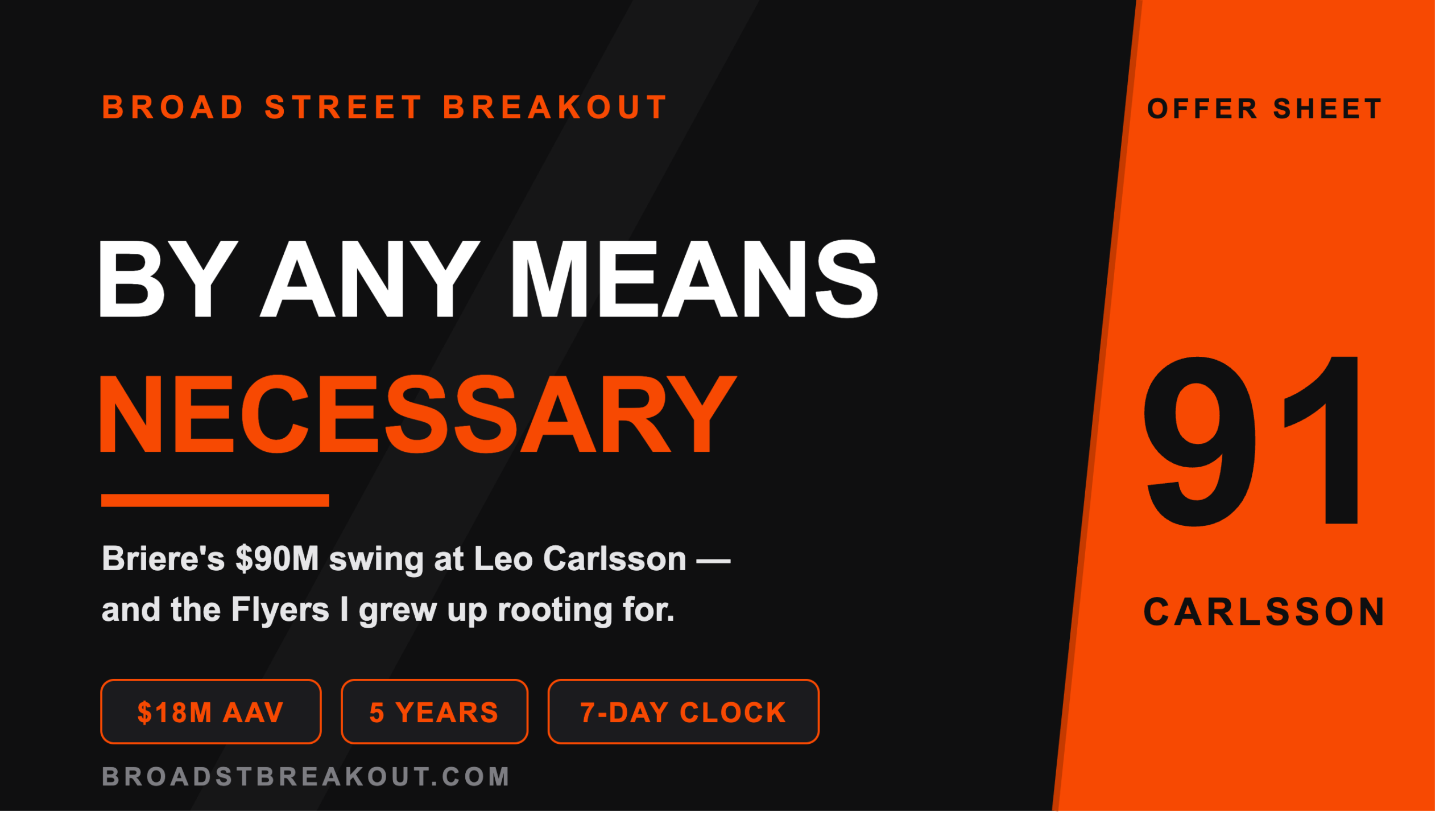
Danny Briere’s $90 million offer sheet for Leo Carlsson is a win for the Flyers — and for the NHL — whether or not Anaheim matches.
I was born in 1994, and I laced them up for the first time in 1999, five years old and desperate to be John LeClair. I wore number 10 because he did. Years later I switched to 4, and then to 44 — that one for Kimmo Timonen. My jersey numbers are basically a walking timeline of the Flyers I grew up worshipping. My earliest memories of the team are those 1999-2000 clubs: LeClair, JR, Primeau, a building that felt like the center of the hockey universe every single night. Going to games as a kid was the most fun I’ve ever had, and it came with an assumption I didn’t even know I was making: the Flyers were always going to be in the mix. When they hit a rough patch, they didn’t wallow in it. They traded for Peter Forsberg. They went out and got Danny Briere, Kimmo Timonen, Scott Hartnell. For the first twenty years of my life, being a Flyers fan meant rooting for one of the best organizations in the sport — a team that refused to stay down.
Then, somewhere around 2014-15, that feeling quietly died. Outside of the COVID bubble year when they actually went for it, the last decade has been the opposite of the franchise I grew up with: patient to a fault, cautious, drifting. And here’s the part that stings if you really sit with it — there is now an entire generation of kids in this region who have never once felt about the Flyers the way I did as a nine-year-old. To them, “the Flyers” has always meant mediocrity and waiting.
That’s the context I want you to hold onto, because it’s the real reason Friday afternoon mattered so much. At a little after 3 PM on July 3, Danny Briere threw a bomb into the middle of the NHL: a five-year, $90 million offer sheet for Anaheim’s 21-year-old franchise center, Leo Carlsson. An $18 million AAV that would instantly make him the highest-paid player in hockey. Whatever happens next, that move was the Flyers announcing, out loud, that they are done drifting.
The mechanics, fast
Carlsson has already signed. This isn’t an “offer” he’s mulling over — his name is on the paper, and this is his next contract. The only open question is which crest is on his chest. Because he’s a restricted free agent, Anaheim has seven days — until roughly July 10 — to match. Match it, and he stays a Duck. Decline, and the Flyers get their first true No. 1 center of the Briere era while surrendering four first-round picks (2027 through 2030) as compensation.
The structure is the whole point. The deal is heavily front-loaded and stuffed with signing bonuses — per Sportsnet’s Elliotte Friedman, Carlsson takes home around $39 million in the first twelve months alone, and the vast majority of the $90 million is paid out in lump-sum bonuses. That’s not an accident. That’s a weapon, and I’ll come back to why.
As of this writing, Anaheim hasn’t blinked. Pat Verbeek won’t comment until the process is done. So let’s talk about what this actually means.
Briere is still moving in silence — just like he always has
I’ve said it before and this move only makes me more sure of it: Danny Briere is the best general manager the Flyers have had since Bob Clarke and Paul Holmgren, and he’s spent his entire second career being underrated exactly the way he was as a player. As a Flyer, Briere was very good in the regular season and elite in the playoffs — the kind of guy who got bigger when the lights got brighter — and people still somehow slept on him. He’s built his front-office career the same way. Quiet. Relentless.
When he retired, he didn’t coast on his name. He went to Holmgren to get his foot in the door on the management side, and — this is the part people forget — he went back to school and completed a two-year executive General Management program at the Wharton School from 2019 to 2021. He has been grinding, nonstop, to become the Flyers’ GM and then to be good at it. Have there been hiccups? Sure. Every rebuild has them. But moves like this are why I trust the vision.
Here’s the cold reality of trying to acquire a genuine 1C in this league. You have three paths. You bottom out for years and pray you win a lottery — the Flyers half-did this and it’s brutal, slow, and unreliable. You make a monster trade — but these players almost never come available, because no sane team trades a young franchise center. Or you do this. Carlsson was one of the only ways left to plug the single biggest hole on the roster without tanking for three more years and hoping the ping-pong balls love you. Briere found the door and kicked it in.
Why this is a win for Philly even if it doesn’t work
Let me get ahead of the obvious pushback: most of the hockey world thinks Anaheim matches. Doug MacLean said flatly there’s no way the Ducks let him walk, and every serious analyst leans the same direction. So what does Briere actually win if Carlsson ends up back in Anaheim?
More than you think.
For a decade, the book on the Flyers around the league — among rival GMs, among players, among agents — was that they were too patient, that they wouldn’t take a big swing. That reputation is now dead. Every player in the NHL just watched Philadelphia try to make a 21-year-old the highest-paid man in the sport. The Athletic’s Kevin Kurz called the move “creative,” and that’s the right word — but the more important word is loud. The Flyers just told the entire league that the coffers are open and Philadelphia is a destination that will pay for top-end talent. You cannot buy that message. Briere just sent it for the price of a signature. If it also lands the player, incredible. But the signal alone moves the franchise forward, and that’s why I lead with it instead of burying it.
Yes, it’s an overpay. That’s the point.
I’m not going to insult you by pretending this is an efficient contract. It isn’t, and it isn’t close. The best public models peg Carlsson’s current market value around $13.1 million against this $18 million cap hit, with something like a 6% probability of the deal producing positive surplus value. The Athletic’s Dom Luszczyszyn hammers this in his analysis: for now, Carlsson is a solid 1C, not an MVP, and $18 million requires MVP-level, top-five-in-the-world production he simply hasn’t delivered yet.
All true. And I’d sign it again tomorrow.
Because that inefficiency is the mechanism. If Briere had offered a fair number, Anaheim matches in thirty seconds and nothing happens. The overpay is what turns a routine RFA negotiation into a genuine crisis for the Ducks. As PHLY’s Charlie O’Connor put it, doing this for a 21-year-old with sky-high upside when the rest of your balance sheet is clean and you’re sitting on a mountain of cap space is “the best method of overpayment possible.” You are never getting elite talent at this position at a discount. The overpay is the cost of admission to the tier the Flyers have lacked for a generation.
And here’s the bet I actually love. Look at where this core is in five years, when this deal ends: Carlsson is 26, Porter Martone is 24, Matvei Michkov is 26, Jamie Drysdale is 29, Trevor Zegras is 30, Cam York is 30. That’s an entire young core hitting its literal prime together, at which point Carlsson’s next contract — negotiated by a Flyers team that’s now his home — can very plausibly come in lower as a percentage of a much higher cap. You overpay now to acquire the player you can’t otherwise get, and you bank on the relationship and the timeline to make the next deal the friendly one. That’s not reckless. That’s a plan.
Anaheim is in a real bind — and not just on the spreadsheet
Everyone’s focused on the cap math. The more interesting pressure is cultural, and it’s self-inflicted.
Start with reputation. In a survey of NHL player agents conducted by The Athletic this spring — from March 29 to April 9, before any of this drama — agents were asked which front office is the hardest to deal with. Anaheim ran away with it, seven votes, more than any other team in the league. That’s not a coincidence, and it’s not new. Verbeek has a well-documented pattern of playing hardball with his own young stars until it curdles: Trevor Zegras, Jamie Drysdale, and Mason McTavish all held out, and all three ended up traded. The Athletic’s Eric Stephens said it plainly — playing the waiting game with his very best player backfired.
Which raises the question Stephens keeps asking and I can’t stop thinking about: the Ducks were suddenly eager to lock Carlsson up long-term this summer. Where was that eagerness a year ago, on the first July 1 they could have signed him for a fraction of $18 million? If you let a franchise player’s price compound while you squeeze him over relatively small money, this is how it ends. Relationships in this business are currency, and Verbeek has been spending his down for years.
Now the bonus angle, which is the sharpest blade in the whole thing. Brandon Sommermann did the homework here, and it’s damning: he checked every Anaheim re-signing and found that “not one of their re-signings have signing bonuses” — the only bonus deal on the books belongs to Chris Kreider, who was acquired via trade. The Ducks, as an organization, simply do not pay signing bonuses. And now Briere has handed them a contract that demands a $19.95 million lump-sum bonus check within seven days of matching.
Yes, Henry Samueli is a billionaire. That’s not the point, and framing it as “the owner can’t afford it” is the easy version any Ducks fan will swat away. The real point is that being a billionaire doesn’t mean a franchise keeps that kind of liquid cash sitting around to hand out on a week’s notice, and — more importantly — it forces an ownership group that has deliberately built its entire contract philosophy around avoiding these payments to violate that philosophy in public, under duress. It’s precedent pressure and cash-flow pressure at the same time. That’s a much harder thing to shrug off.
And this is where the numbers get uncomfortable for Anaheim. Samueli is personally worth somewhere around $27 billion, most of it Broadcom stock. But the man’s capital is spoken for. He’s pouring a reported $1 billion into renovating Honda Center and billions more into the OCVibe entertainment district surrounding it. Meanwhile the Ducks themselves are a lean business, not a cash geyser: Forbes ranks them 26th of 32 in the NHL, they finished 29th in the league in home attendance last season, and Bill Meltzer, citing Forbes, pegged the team’s operating income at roughly $26 million. Now line that up against the deal. Because signing bonuses are paid as lump sums at the start of each league year, matching means writing a $19.95 million bonus check almost immediately — and then another one, $18.1 million, on July 1, 2027. That’s roughly $38 million in bonus cash out the door inside the first twelve months, which is what Friedman and Chris Johnston reported. Read that again: a franchise with about $26 million in operating income would have to pay out around $38 million in signing bonuses to one player before next fall. Two enormous checks, twelve months apart, from a business whose entire model was built to never write them. As Meltzer put it, matching means tearing up their entire way of doing business — and letting a competitor dictate the terms.
And here’s the detail that makes me think Briere knew exactly which buttons to push: his senior advisor is Bob Murray, who ran Anaheim’s front office for over a decade before Verbeek. You have to think a man who spent that long inside that building knows precisely how ownership thinks about writing big checks. This offer sheet looks engineered — and it looks engineered by someone with the blueprints.
Either way, Anaheim’s cheap-contender window is closing
Here’s what I want Ducks fans to actually sit with. Even in the scenario where they match and “win,” they don’t win much.
Match, and by Stephens’ accounting they’re left with roughly $19 million in space — enough to sign RFAs Cutter Gauthier and Pavel Mintyukov this summer, but with essentially nothing left for in-season flexibility. Remember, they’ve already lost four defensemen this offseason in Trouba, Gudas, Carlson, and Zellweger. They’re thin, and matching leaves them no money to get less thin.
Then the real problem arrives on a delay. Gauthier isn’t offer-sheet eligible, so Anaheim keeps him — he just costs more now, because no 40-goal scorer is taking a discount in a high-tax state while his linemate makes $18 million. Beckett Sennecke’s new deal lands in 2028. Stack those together and, as Luszczyszyn lays out, that trio could eat $40-45 million in combined cap — at which point building an actual contender around them becomes almost impossible. The players don’t vanish. The cheap, flexible, build-a-winner-around-them window vanishes. That window was the entire premise of Anaheim’s rebuild, and this offer sheet quietly forecloses on it whether Verbeek matches or not.
And if they don’t match? They hand a rising Metro rival four first-round picks — likely landing in the late teens or twenties, per Luszczyszyn’s simulations — and they’re left with no franchise center, the exact player they tanked for years to draft and develop. Which is why Luszczyszyn’s conclusion is the perfect encapsulation of Verbeek’s nightmare: Carlsson isn’t worth $18 million a year, but “he’s also worth more than four ‘meh’ firsts.” Both things are true. That’s the trap.
If the Flyers do get him
I won’t pretend it’s frictionless on our end. Adding Carlsson turns Philadelphia back into a cap team and forces a move — a Noah Cates, an Owen Tippett, a Rasmus Ristolainen going out to make the math work. That’s real. But those players have genuine trade value, the Flyers can exceed the ceiling by 10% in the offseason to buy time, and critically, they keep the Toronto first-round pick from the Scott Laughton trade even in the no-match scenario. That Leafs pick backfills one of the four they’d surrender, and given Toronto’s outlook it could be a high one. Add in a prospect pool that’s absorbed more than 30 picks over four years, and the pipeline can take the hit. This is a team built to survive winning this bet.
Why this is great for the whole league
Zoom out, because this is bigger than Philadelphia.
What Briere really did Friday was send a message to every star in the NHL: if you want to get paid, force the issue — get to free agency, or make your team sweat an offer sheet — and teams like the Flyers will be there with a blank check. Even if this just makes a few more guys willing to test the market, that’s fantastic for the sport. Friedman framed the new reality perfectly: “If you have great players, sign them for as long as you can,” because the price only ever goes up. This is the fourth offer sheet in 23 months. The resistance to them is collapsing.
I’ll be honest about where I land on player empowerment. I think the NBA has gone too far — it’s a league now essentially run by its players. But you cannot tell me it isn’t thrilling every single offseason, watching stars get moved and chase their situations. The NHL has lacked that energy for my entire adult life, and I always blamed the flat, stagnant cap for killing it. Well — that world is over. The cap is exploding, from $104 million this year to a projected $113.5 million next and $140 million-plus by the time Carlsson would hit free agency. A rapidly rising cap colliding with the league’s dying aversion to offer sheets is exactly the recipe for the chaos I’ve been begging for. Friedman said it best: everything is different now.
Back to that kid in 1999
I don’t know if the Flyers will get Leo Carlsson. If I’m betting, Verbeek probably grits his teeth and matches, because a 3,000-penalty-minute lifer who spent all week promising he’d match any offer will feel he has no choice but to follow through. Fine. I can live with that outcome, because I’ve spent this whole piece explaining why it still works.
But that’s not really what Friday was about for me. It was about a franchise that spent ten years teaching a generation of kids to expect mediocrity finally standing up and saying: not anymore. Ed Snider would have loved this — Friedman’s right about that. It’s a return to the Broad Street identity I grew up worshipping, the one where the Flyers were never content to be down, where they went out and got the guy.
Win or lose Carlsson, Danny Briere just told the entire hockey world that the Flyers are back to doing whatever it takes. By any means necessary. And for the first time in a long time, I believe him.
Sources & further reading
A lot of the reporting and analysis that shaped this piece came from writers doing excellent work on this story. Full credit to them — go read the whole thing:
- Charlie O’Connor, PHLY — Answering all the big questions on the Carlsson offer sheet
- Kevin Kurz, The Athletic — How far the Flyers are willing to go to take the next step
- Eric Stephens, The Athletic — Why the Ducks must match at all costs
- Dom Luszczyszyn, The Athletic — Should the Ducks match the offer sheet?
And the reporting that broke the details in real time:
Elliotte Friedman on Anaheim’s promise to match any offer sheet:
PuckPedia’s full year-by-year breakdown of the contract structure:
Brandon Sommermann on the Ducks’ history of avoiding signing bonuses:
Bill Meltzer (@billmeltzer) — on the Ducks’ business model and why matching means tearing it up
And on the full no-trade clause tucked into the final year:
Broad Street Breakout — where coaching meets the numbers.
Discover more from Broad Street Breakout
Subscribe to get the latest posts sent to your email.
Talk hockey on X. Watch the film breakdowns on Instagram.
One response to “By Any Means Necessary”
This was really well written and I share in believing the action of the offer sheet and acceptance of Carlsson were the most important things. Thank you for the outstanding article and thank you Danny B for being you!!!