
Remember when I wrote in my pre-draft breakdown that Porter Martone would “likely be off the board before the Flyers pick?”
Yeah, about that.
Sometimes being wrong feels pretty damn good.
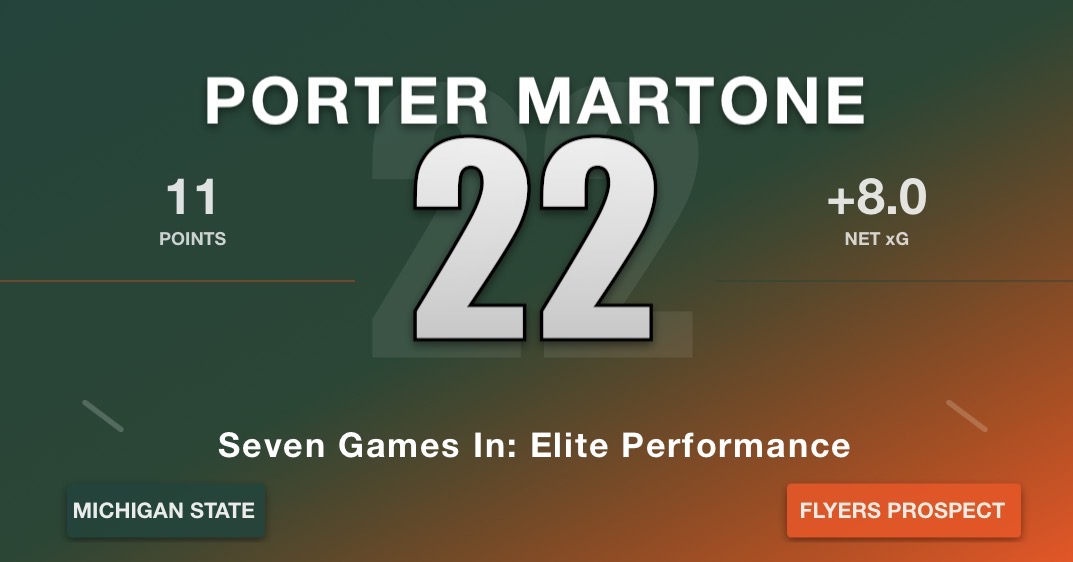
Seven games into his Michigan State career, the Flyers’ 6th overall pick isn’t just meeting expectations—he’s crushing them. With 11 points (4 goals, 7 assists) through seven games, Martone is doing exactly what I predicted he would: dominating from high-danger areas, operating on the power play like a young Stamkos, and—here’s the kicker—making everyone around him significantly better.
The question I had back in May wasn’t whether Martone could produce against OHL competition. We knew he could do that. The real test was how quickly his game would translate against bigger, stronger, more mature competition at the college level.
Spoiler alert: The translation is going just fine.
Let’s dig into the advanced stats—and I promise I’ll actually explain what they mean—to see if the player we scouted in Brampton is the same one dominating in East Lansing.
Understanding the Numbers (The Important Stuff)
Before we dive into Martone’s specific performance, let me break down a few key metrics that tell us how impactful he’s really been. Think of these as the “why” behind the “what.”
Net xG (Expected Goals): This measures the quality of scoring chances a player generates versus what they give up when on the ice. A positive number means you’re creating more dangerous chances than you’re allowing. Martone’s sitting at +8.0, which is the best on Michigan State. Translation? When he’s on the ice, the Spartans are generating elite scoring opportunities while shutting down opponents.
CORSI: This tracks all shot attempts (shots on goal, missed shots, and blocked shots) when a player is on the ice. It’s a possession metric—higher is better. Martone’s line has a +59 CORSI at 5-on-5, meaning they’re absolutely dominating puck possession.
Shooting Percentage by Zone: This shows where a player is taking shots from and how often they’re converting. High percentages from dangerous areas (the slot, in front of the net) indicate good shot selection and finishing ability.
Now, let’s see how Martone stacks up.
The Net-Front Game Hasn’t Just Translated—It’s Thriving
In my pre-draft analysis, I tracked 45 of Martone’s goals in the OHL and found that 31 came from in front of the net—a ridiculous 68.9% rate. My concern? Would that translate when he’s playing against 22-year-old defensemen who’ve been hitting the weight room for four years?
The answer is an emphatic yes.
Watch how Martone operates here. The puck goes behind the net and he immediately crashes hard, eyes scanning, waiting for it to find its way through. This isn’t luck—this is a player who understands where goals are scored and has the hockey IQ to get there at the right time. When the puck comes through, he buries it easily.
According to his shot chart data, Martone is getting 63.6% of his shots from the slot off and onto the net, he’s not missing and they’re not getting blocked.

Just like back in juniors, you cannot leave Porter Martone uncovered in front of the net. He’s so good at coming down low when others are battling for the puck, and if that puck finds a way through out front, he’ll find it and bury it every single time. The defensemen know he’s there, they’re trying to box him out, but his combination of size, timing, and hands makes him nearly impossible to contain in that area.
Here’s another example of his net-front mastery. Martone’s battling for positioning with the defenseman in front, puck moves low to high, then D to D. Right as the shot is coming, he pops out just a little for extra space and redirects this one in. The timing, the hand-eye coordination, the awareness of where the puck is coming from—this is high-level stuff.
The shot chart also reveals something encouraging: he’s not forcing plays from bad angles. His 0-for-3 from behind the net shows he understands shot quality. He’s picking his spots, and when he shoots, it’s usually going in.
But He’s Not Just a Net-Front Guy
This goal is unbelievable. In theory, it’s just outside the dot line—not exactly where you’d coach most players to shoot from on a 2-on-1. But when you have a shot as good as Martone’s, you let him take it. He buries this one off the rush, and it’s a reminder that while he dominates from the net-front, he’s got legitimate finishing ability from distance too.
This versatility is what separates Martone from typical power forwards. He’s not one-dimensional. He can score from multiple areas, which makes him that much harder to defend.
The Playmaking That’s Elevating His Linemates
Here’s where things get really interesting. We’re seeing Michkov and Zegras operate so well below the net for the Flyers right now, making plays that most wingers can’t make. Martone’s doing the same thing at Michigan State.
Watch this primary assist. He’s behind the net, the goalie cheats over to the strong side, and instead of rushing out front, Martone slides it back the other way as his teammate comes crashing down for the goal. The vision here is outstanding. This is the kind of play that shows his hockey IQ is NHL-ready.
Another great play showing his awareness. Martone picks off this breakout pass at the blue line. Most of the BU team had fled the zone looking for a quick transition the other way. Martone skates in, sells the shot, and as he’s moving from middle to right, he pulls the defender with him. The goalie overcommits for a shot, and Porter slides it right under the diving defenseman to his teammate for a goal.
This is patience. This is vision. This is understanding how to manipulate defenders and goalies.
Martone’s also creating offense through sheer volume and pressure. Here, the puck comes from behind the net, the goalie tries to push it back, and Martone—standing right on the goal line—immediately fires it. It’s not the prettiest shot, but that’s not the point. He creates a rebound, and his teammate buries it in tight.
Martone shoots so much that it’s not always about scoring on that immediate attempt. It’s about creating pressure, generating rebounds, and manufacturing scoring chances for himself and others. That’s what great players do.
The Line That’s Carrying Michigan State
Here’s where the advanced stats start painting a picture of just how dominant Martone has been at even strength.
Watch this clip. Martone starts by forechecking with heavy pressure on the puck carrier behind the net. He forces a turnover, quickly moves it from low to high up to the defenseman. What I love here is that he doesn’t just stand there—he’s immediately moving to the net for a screen opportunity, stick up looking to tip. He doesn’t get the tip himself, but there’s a lot to like in this sequence where he picks up the secondary assist.
At 5-on-5 (even strength, no power play), Martone has been deployed primarily with center Charlie Stramel and right wing Dan Russell. These three have formed Michigan State’s most lethal combination, and the numbers are staggering:
- 8 goals for, only 2 against
- +6 Plus/Minus (best of any line on the team)
- 72 minutes of ice time together (most of any forward combination)
- CORSI +59 (they’re dominating possession)
For context, the next-highest scoring line at even strength? One goal.
Martone’s line has eight.
This clip shows his processing speed. Someone feeds Martone in the slot, the defenseman has a tight gap, and if you slow it down, you can see Porter actually pokes this puck toward the corner. He chases it down, wins the battle, and immediately moves it to the high slot where that player hits the defenseman crashing down on the far side for a goal.
This isn’t just about Martone putting up points—though his 11 points (4G, 7A) means he’s directly involved in more plays than his entire line has goals, suggesting he’s also producing on special teams and with other combinations. This is about him elevating his teammates and driving results at 5-on-5, which is where NHL teams really separate themselves.
His 10 passes to the slot (3rd on the entire team) show he’s not just finishing plays—he’s creating them. When Martone’s on the ice, Michigan State is generating elite scoring chances (12.0 xG for) while keeping opponents off the board (3.9 xG against). That +8.0 Net xG differential is team-leading, and it’s not particularly close.
The Two-Way Game That’s Going to Make Tocchet Salivate
Here’s something that might surprise casual fans: Martone isn’t just producing offense. He’s playing a complete, two-way game that’s going to have Rick Tocchet practically drooling when this kid eventually makes it to Philadelphia.
This is a great clip showing his engagement away from the puck. Martone wins a mini battle and immediately gets a shot on net from the low slot. The goalie saves it, and he’s immediately out of the zone as BU pushes the other way. He comes right back through the middle on the backcheck and lays a clean, big hit on the BU forward, which gains Michigan State possession going right back into the offensive zone.
Good clip of Martone chasing a loose puck. The Northern Michigan player sees him coming and releases the puck early, but Martone finishes his hit anyway. This is the kind of engagement and physicality that coaches love. He’s not taking plays off, he’s finishing checks, and he’s making life difficult for opponents.
In my pre-draft breakdown, I showed a clip where Martone got lazy with his positioning, reaching for pucks instead of moving his feet. Playing against weaker OHL competition had created some bad habits, and I was concerned about how that would translate.
Well, those habits? They’re gone.
Martone’s defensive metrics are quietly excellent:
- Team xG when on ice: 12.0 (tied for 2nd on the team)
- Opponent’s xG when on ice: 3.9 (2nd lowest—meaning opponents aren’t getting quality chances)
- 52% puck battle win rate (solid for an 18-year-old freshman)
- 7 blocked shots from the slot (tied for team lead)
That last stat is particularly telling. Martone isn’t just getting to the net-front on offense—he’s protecting it on defense. He’s blocking shots in the most dangerous area of the ice, showing he understands defensive positioning and isn’t afraid to pay the price.
His 62 CORSI rating and strong possession numbers show he’s engaged away from the puck. He’s not cheating for offense or taking shifts off defensively. The 27 takeaways might not jump off the page, but combined with his puck battle success and positioning, it paints a picture of a player who’s thinking the game at both ends.
This is the kind of two-way play that Tocchet demands from his players. If Martone keeps this up, he’s not going to have the same growing pains that other offensive prospects face when they hit the NHL.
What It All Means (The Big Picture)
Let’s step back and look at what we’re actually seeing here.
In seven games at Michigan State, Porter Martone has:
- Leads the team in points (11)
- Leads the team in Net xG (+8.0)
- Anchored the only 5-on-5 line that’s consistently scoring (8 goals vs. 1 for other top lines)
- Hit the net on 63.6% of his slot shots (continuing his net-front dominance)
- Shown offensive versatility (scoring from multiple areas, creating for teammates)
- Played a complete two-way game (7 blocked shots from slot, strong backcheck, finishing hits)
The patterns from the OHL aren’t just translating—they’re thriving. The net-front dominance is there. The playmaking ability is there. The hockey IQ is there. And most importantly, the two-way engagement that was sometimes lacking in junior hockey? That’s there too.
Is seven games a small sample size? Sure. But these aren’t fluky numbers. These are patterns. When you’re leading your team in Net xG, carrying the only productive even-strength line, and converting at a 63.6% rate from high-danger areas, you’re not getting lucky—you’re doing something right.
Bottom Line
In my pre-draft piece, I concluded with: “Martone has legitimate top-line upside if his skating continues improving. He’s not the bruiser some expect… but rather a skilled power forward who happens to be 6’3”. That combination is rare and exactly why he’ll likely be off the board before the Flyers pick.”
I was wrong about that last part—and I’ve never been happier to be wrong.
The Flyers got a player at 6th overall who’s already proving he belongs on a top line. The net-front dominance is real. The playmaking skill is real. The two-way game is developing ahead of schedule. And perhaps most importantly, he’s making everyone around him better.
His line has scored 8 even-strength goals while the rest of Michigan State’s top combinations have managed just one each. That’s not coincidence—that’s impact.
Seven games is early, but the foundation is there. Porter Martone isn’t just who we thought he’d be. He’s getting there faster than anyone expected.
The rebuild in Philadelphia just got a whole lot more exciting.