
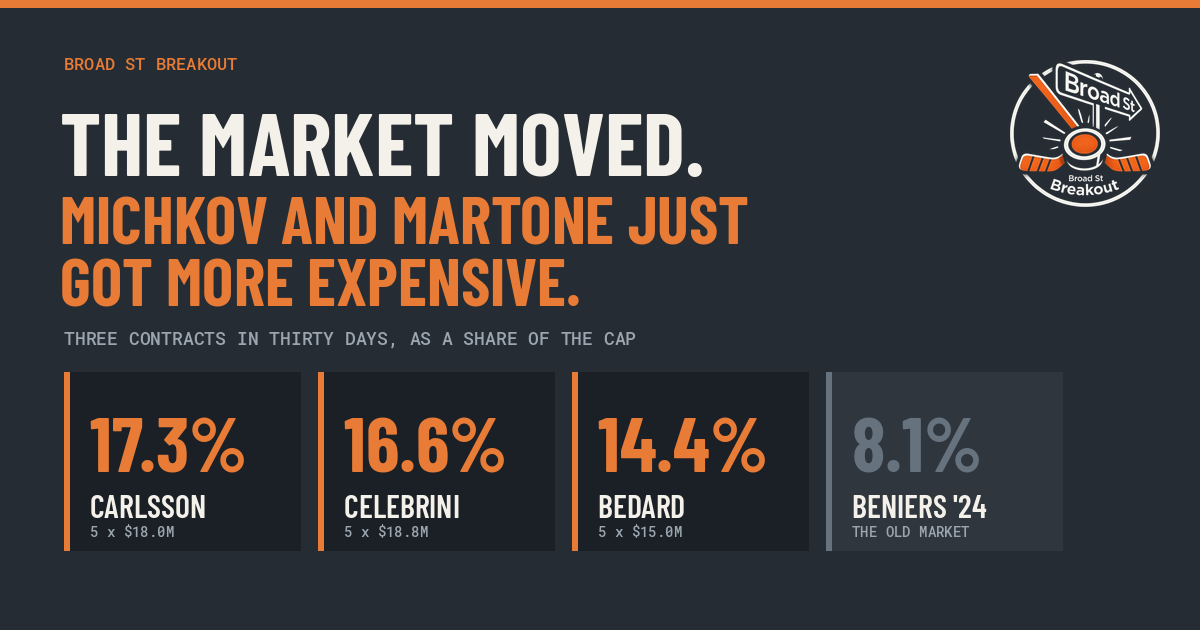
Three contracts got signed in about a month and they changed what a young star costs in this league.
Leo Carlsson went five years at $18 million. Connor Bedard went five at $15 million. And Friedman is now reporting Macklin Celebrini at five years and $18.8 million, which would make him the highest-paid player in hockey.
The Flyers have two guys getting paid off those comparables. Matvei Michkov is a restricted free agent in eleven months. Porter Martone becomes extension-eligible the same summer. Neither of those numbers is going to be small.
This isn’t just the cap going up
The easy dismissal is that the cap jumped from $88 million to $104 million, so of course contracts got bigger.
That’s not what happened. Here’s the group measured as a share of the cap in the first year of each deal, which is the only way to compare across seasons:
| Player | Deal | Cap share |
|---|---|---|
| Carlsson | 5 x $18.0M | 17.31% |
| Celebrini | 5 x $18.8M | 16.56% |
| Kaprizov | 8 x $17.0M | 16.35% |
| Bedard | 5 x $15.0M | 14.42% |
And here’s what the same tier of player signed for eighteen months ago:
| Player | Deal | Cap share |
|---|---|---|
| Raymond | 8 x $8.075M | 9.18% |
| Caufield | 8 x $7.85M | 9.40% |
| Beniers | 7 x $7.14M | 8.11% |
| Lafrenière | 7 x $7.45M | 7.80% |
Elite young forwards used to cost eight to ten percent of the cap. Now they cost fourteen to seventeen. That’s a different market, not a bigger version of the same one.
One thing on Celebrini that’s going to get written up wrong everywhere: $18.8 million is a bigger number than Carlsson’s $18 million, but it’s a smaller slice. Celebrini’s deal starts in 2027-28 against a $113.5 million cap. Carlsson’s starts this year against $104 million. Carlsson is still the biggest contract ever signed coming off an entry-level deal, at least in the currency that matters.
All three took five years
Carlsson, Bedard, Celebrini. Every one of them could have signed for eight. Celebrini had until September 16 to take the last eight-year deal the new CBA will ever allow and he passed on it.
Three for three isn’t an accident. Five years off an ELC gets you to unrestricted free agency at 25 or 26 with an open market bidding on you. These guys have decided hitting UFA young is worth more than the security of a long deal.
J.P. Barry represents Michkov. He can read that table as well as anybody.
What Michkov actually costs
I don’t think there’s one honest number here, so I built a model instead. Set his season, get his price. Roughly where it lands against the $113.5 million cap his deal would start on:
| 2026-27 points | Cap share | AAV |
|---|---|---|
| 45 | 6.0% | $6.8M |
| 55 | 8.0% | $9.1M |
| 65 | 10.5% | $11.9M |
| 75 | 13.0% | $14.8M |
| 85 | 15.0% | $17.0M |
He put up 51 last year and 63 as a rookie. After the Olympic break he was on a 69-point pace, which is the number I’d bet on if the conditioning stuff is real.
So an ordinary bounce-back, the kind that doesn’t generate a single column, costs about $12 million. The season the Flyers actually drafted him to have costs closer to $15 million.
They have $28.48 million of room in 2027-28 with five roster spots to fill.
Martone is the one nobody’s pricing yet
This is the part I think gets missed.
Martone signed his ELC on March 29 and debuted two days later. He played enough regular season games to burn the first year, which PuckPedia’s contract table confirms. His deal now runs through 2027-28, so he’s extension-eligible July 1, 2027 and an RFA July 1, 2028.
The sample was short and it was absurd. Thirteen points in his first twelve NHL games between the regular season and playoffs. He scored his first career goal in overtime, the first Flyer to ever do that. Then he became the first teenager in NHL history to score game-winners in each of his first two playoff games. He was also College Hockey News and USCHO Rookie of the Year at Michigan State with 50 points as a freshman.
Broad Street Hockey noted his down-the-stretch rate extrapolates to 91 points over a full season. Nobody thinks he does that. But he’s a 6-foot-3 right shot who was over a point per game as a 19-year-old and got better when the games got harder.
Run him through the same curve. If Martone puts up 65 points in his real rookie year, he’s a $12 million player on his second contract. At 75 points he’s near $15 million.
And his deal starts in 2028-29, which is the same year Alex Bump, Denver Barkey, and David Jiricek all need new contracts, and the same year Michkov’s raise is already on the books.
The September problem
The new CBA takes full effect September 16. On that date the maximum term drops from eight years to seven for re-signing your own player.
Flyers camp opens September 17.
So they don’t get to watch a single practice of an in-shape Michkov before the last eight-year deal in franchise history expires. They’d be deciding on faith, on video from Perm, and on whatever the coach they sent to Russia for two weeks tells them.
That’s just bad luck on the calendar, but it makes the question real instead of theoretical.
I’d make the offer
If it were me I’d put a real number in front of him before September 16. Not a bridge, not a lowball. Eight years somewhere around $10.5 to $11.5 million, which is nine or ten percent of the 2027-28 cap.
Here’s my reasoning.
Every good game he plays raises the price. That’s not a guess. Carlsson’s camp turned down $10.5 million per season last fall and got $18 million in July. Raymond cost Detroit money by putting up 20 points in his last 18 games before signing. Waiting has a dollar cost and teams keep eating it.
The market is only moving one direction. Three straight elite young forwards signed for a bigger cap share than the guy before them relative to their tier. The cap goes up another $9.5 million in 2027-28. Nothing in the current environment makes him cheaper next summer.
He also has more leverage than people realize. He signed his ELC at 20, so he needs four professional seasons for arbitration rights and he’ll have three. No arbitration. But Group 2 restricted free agency only requires three seasons, so he can absolutely sign an offer sheet in July 2027. The Flyers spent this whole summer showing the league that a $90 million offer sheet is a normal thing to do. Somebody was taking notes.
Locking in a number is also the only way the bigger plans work. Quinn Hughes hits unrestricted free agency in July 2027. You can’t plan a $17 million signing around a Michkov number that might be $7 million and might be $15 million.
The honest counterargument
He has one good half-season and one bad full one. He got scratched twice in the playoffs and has one assist in eight career postseason games. Tocchet still hasn’t built a role for him.
Signing now means paying for a player you’re projecting off a summer training video. Dylan Cozens got seven years and $7.1 million on one hot half-season and was traded before the deal hit the halfway point.
And if you wait past September 16 you’re capped at seven years, which pushes the annual number up rather than down, because you’re spreading the same money over less term.
I’d still make the offer. Overpaying by two million a year is survivable. Watching him put up 80 points and then negotiating against an offer sheet in a market where Celebrini just cleared 16.5 percent of the cap is a lot worse.
Run it yourself
The model below prices Michkov, Martone, Bump, Barkey, and Jiricek off whatever seasons you want to give them. You can heat the market up or cool it off, clear a contract, and drop a big free agent in to see what breaks.
The curves aren’t gospel. They’re fit to real second contracts and reweighted for what just happened. The point is to see how narrow the gap is between a team that can add an elite player and a team that spends four years explaining why it couldn’t.
Broad St Breakout / Cap Model
Points in,
dollars out
Three contracts in thirty days reset what young stars cost. Give each player a season and the model prices the contract that season earns against a rising cap.
The reset, as a share of the cap
5 x $18M
5 x $18.8M
5 x $15M
the old market
How hot is the market when these deals get signed?
Clear salary · every one of these has trade protection
Chase an elite free agent
2027-28
CAP $113.5M · CONFIRMED
Space remaining
$0.00M
2028-29
CAP $123M · PROJECTED
Space remaining
$0.00M
Committed salary via PuckPedia, July 2026. Pricing curves are fitted to second contracts signed 2022 through 2026 and reweighted for the Carlsson, Bedard and Celebrini reset. Estimates, not predictions of any real negotiation. Production alone doesn’t set price, so each player carries a leverage tier reflecting draft pedigree, projected role and RFA rights. Nick Suzuki got 9.4% of the cap off a 41-point season; Noah Cates got 4.5% off 40. That gap is what the tier represents. Michkov’s cap hit carries into both seasons. Hughes and Makar would sign for 2027-28; McDavid, Matthews and Werenski are 2028 UFAs and only hit the second bar. Rosters filled to 23 with league-minimum bodies.
Leave a Reply